
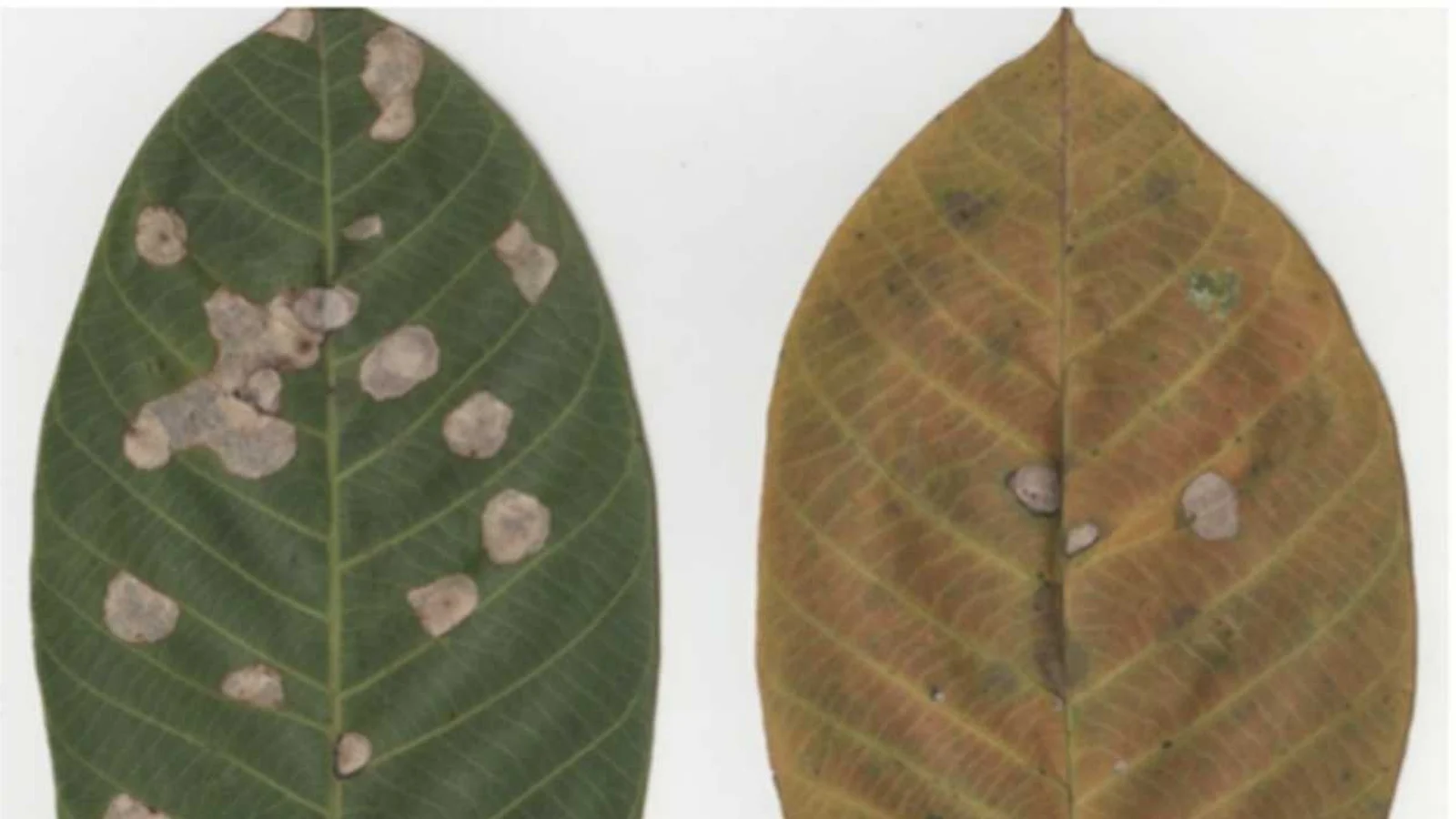
 Photo: Darojat et al. (2024), Industrial Crops and Products 222:119829, Fig. 1C · cropped by RubNex
Rubber leaves keep falling: cut down or treat? What Thai growers must weigh
The new leaf fall disease, or circular leaf spot, has spread to more than 900,000 rai of Thai rubber. RubNex compares Thai and international research on the two options Thai agencies give growers: cut down and replant with a grant, or keep the trees and treat them.
The new leaf fall disease, now often called circular leaf spot, has spread to more than 900,000 rai. Documents from the Rubber Authority of Thailand (RAOT) and the Songkhla provincial agriculture office give growers two options: cut the trees down and apply for a replanting grant, or keep the trees and treat them. RubNex brings together Thai and international research to compare what each path gains and loses.
How far has the disease spread?
Krungthep Turakij reported on 15 October 2026, citing a Ministry of Agriculture and Cooperatives meeting, that from 1 October 2025 to 31 August 2026 a total of 919,529.89 rai of rubber plantations had the disease. Of this, 905,331 rai, or 98.46%, was in the lower South. In August the disease was found for the first time in Phetchabun and Sisaket [2].
The National Agricultural Big Data Center (NABC) reported for 6–12 October 2026 reported the disease in 17 provinces over 919,319.95 rai and rated the trend as "decreasing" [3]. In other words, it has not gone away; it simply did not spread further that week.
The worst-hit provinces are still along the southern border. The director of the RAOT Rubber Research Institute said the outbreak was heaviest in Narathiwat, Pattani, Yala, Satun and Songkhla (data as of 16 June 2026) [4]. In early 2023, the RAOT lower-South regional office also reported Narathiwat as the worst hit: 268,703 rai in that province alone, out of 631,035 rai in total (February 2023 data) [1].
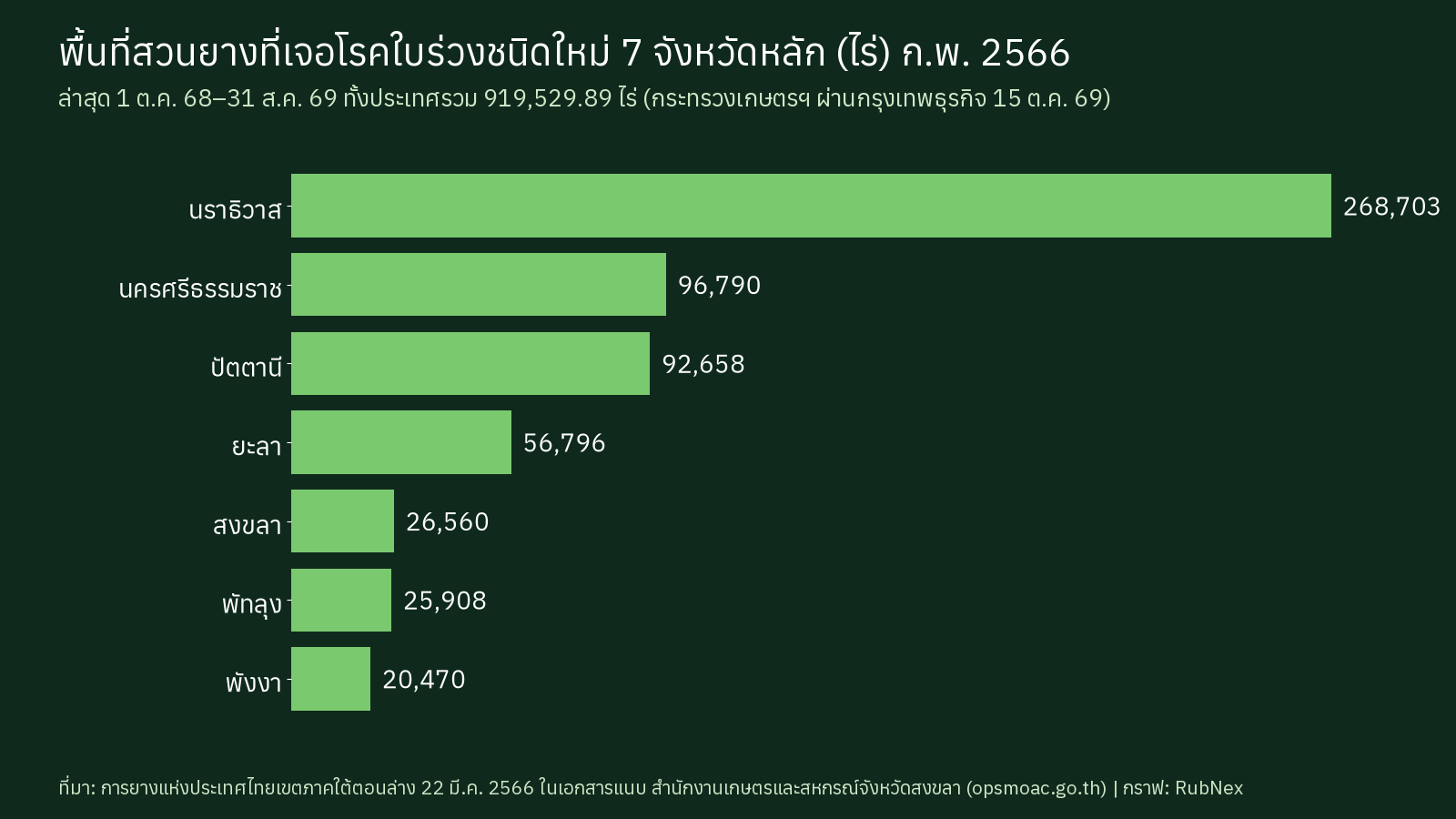
Note: In the source table, Phuket goes from 421 rai (Jan 2023) to 38,820 rai (Feb 2023), Surat Thani from 39,810 rai to 3,270 rai, and Ranong from 3,270 rai to 0 rai. The February figures in these three rows look shifted up by one row, but the table's total (631,035 rai) matches the printed figures. RubNex cannot confirm which figures are correct, so Phuket, Surat Thani and Ranong are left out of the chart [1].
What do infected leaves look like?
The director of the Rubber Research Institute explains that at first the leaf shows fairly round yellow spots, about 0.5 cm wide, visible on both sides of the leaf. The spots then turn dark brown or black, and dry to brown or pale white. Many spots merge into large lesions. Finally the whole leaf turns yellow and falls. The fungus can also enter young shoots, causing dieback from the tip [4].
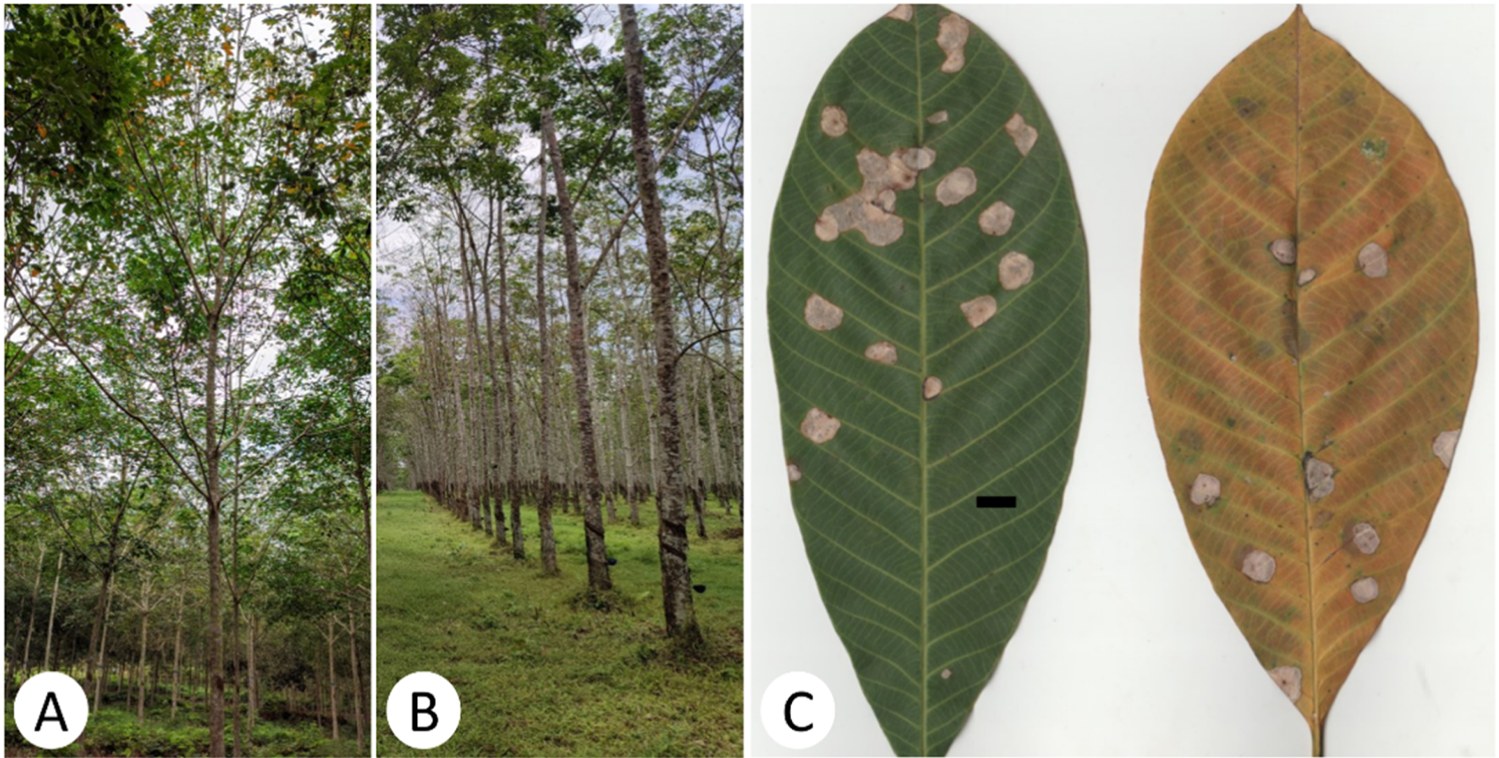
Real photos from a trial plot of the Indonesian Rubber Research Institute: A and B show canopies thinned by leaf fall. C shows leaves of clone PB 260 naturally infected in the field, with circular lesions about 10–20 mm wide (black bar = 10 mm). The study describes this as the circular leaf fall disease that has spread in Southeast Asia since 2018 [13]. Photo: Darojat et al. 2024, CC BY 4.0
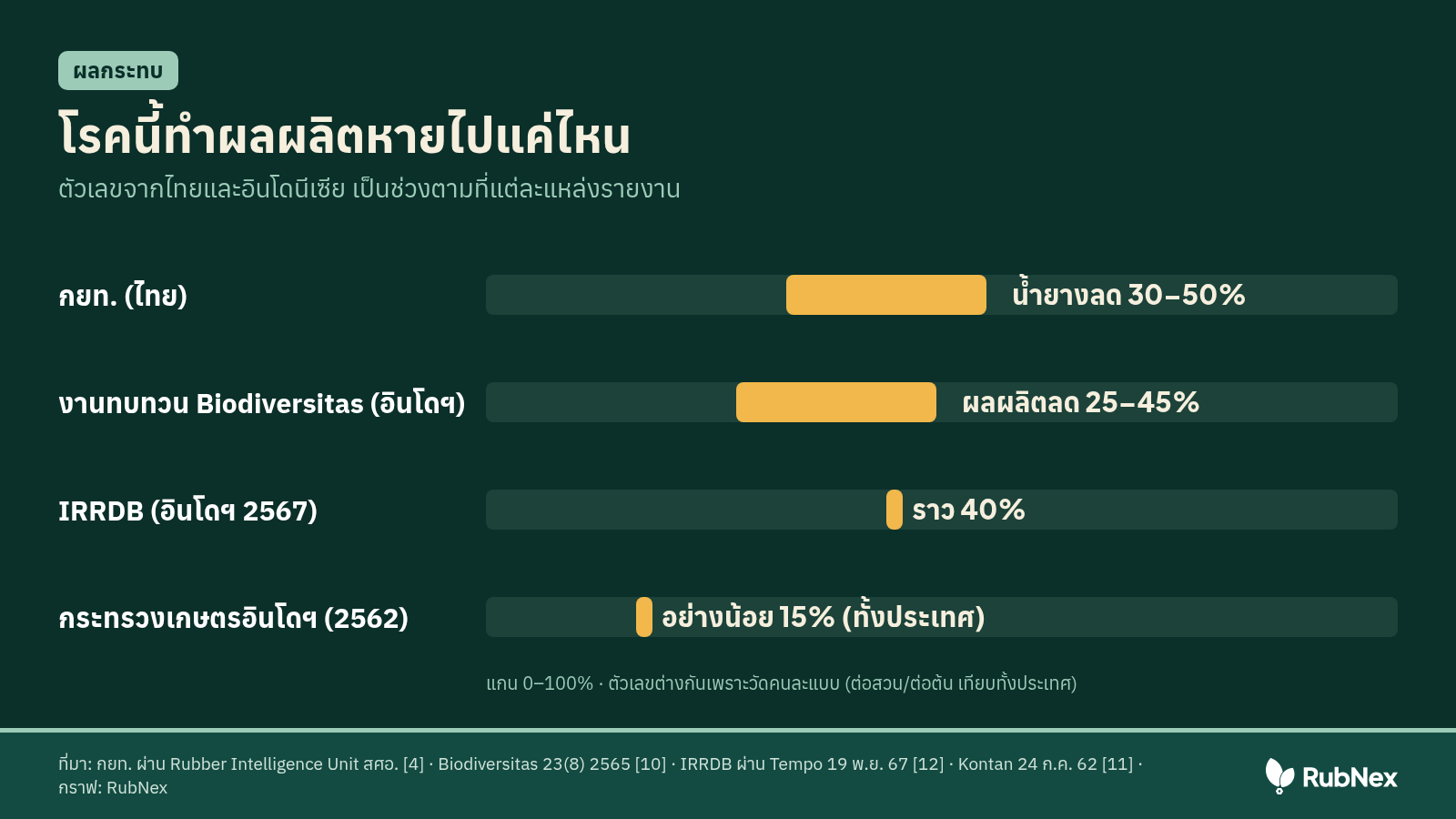
RAOT says the disease cuts latex output by 30–50%, and severe cases can kill trees from the top down [4]. The fungus spreads by wind, rain, rubber seedlings and other plants in the plantation [4], so it spreads fast in the rainy season.
Which fungus is the cause?
Early on, a 2023 Songkhla provincial agriculture document named two fungi: Pestalotiopsis and Colletotrichum [1]. Research now points one way. A Thai team collected rubber leaves from all 13 districts of Narathiwat, isolated 160 samples, and confirmed that the main pathogen is Colletotrichum siamense (published in Agriculture and Natural Resources, 2024) [8]. The RAOT Rubber Research Institute uses the same name [4].
A Malaysian study in the Journal of Rubber Research (2022) found that both C. siamense and Pestalotiopsis could infect leaves only when the leaves were already wounded. It sees Pestalotiopsis as a secondary pathogen that makes things worse [9]. Put simply: healthy trees with undamaged leaves are harder to infect. That is why every recommendation comes back to fertiliser and tree care.
Our neighbours saw it first
Indonesia had the disease before Thailand. Indonesia's Directorate General of Estate Crops, Ministry of Agriculture, said on 24 July 2019 that about 381,000 hectares of rubber were affected (about 2.4 million rai, calculated by RubNex) in 6 provinces, and expected national output that year to fall by at least 15% [11] (1 hectare = 6.25 rai).
Five years later, the Secretary General of the IRRDB (International Rubber Research and Development Board, which brings together the rubber research institutes of producing countries) said at a rubber conference in Yogyakarta on 19 November 2024 that Pestalotiopsis disease had cut rubber yields by about 40%, and there was still no satisfactory solution. The Indonesian rubber industry association (Gapkindo) estimated the disease had spread to no less than 600,000 hectares [12].
A 2022 review in the journal Biodiversitas compiled Indonesian data: the disease causes ongoing leaf fall of 75–90% of the canopy and yield losses of 25–45% [10].
Indonesia's experience shows clearly that this disease does not come for one rainy season and leave. No chemical can stop it completely. Waiting for it to go away is not an option. Growers need a long-term plan.
Option 1: Cut down and replant
Documents from the RAOT lower-South office and the Songkhla agriculture office set out this option. If a grower decides to cut down the trees, they can apply for a replanting grant. They may replant with disease-tolerant rubber clones, switch to other crops, or plant a mixed system [1].
Replanting grants for the 2027 round are now open. Mr Kosol Boonkong, RAOT Deputy Governor for Administration, told Thansettakij on 9 September 2026 that applications run from 1 October 2026 to 31 March 2027 [5].
- Replanting with good rubber clones, or an agroforestry-style rubber plantation: 20,000 baht per rai, paid in instalments over 6.5 years [5].
- Planting economic timber trees or sustainable agriculture: 12,000 baht per rai, paid within 1 year [5].
Conditions to note: the grower must be registered with RAOT, hold a land title document, and the plantation must be 25 years or older, or run-down, damaged, or low-yielding. Most important: after applying, do not cut the trees before RAOT gives permission [5].
Which clones tolerate this disease is still unclear. The Songkhla document describes a top-working trial, in which existing PB 260 trees were bud-grafted with an FX 516 crown, and the new crowns showed no symptoms [1]. But this is still a trial, not a general recommendation. Ask your local RAOT branch before choosing a clone.
Pros: Breaks the disease cycle in the plot, comes with a grant, and is a chance to change clone or crop. Cons: Several years without latex income, the grant is paid in instalments, and with rubber prices still good, cutting down a plantation that can still be tapped means a big lost opportunity.
Option 2: Keep the trees and treat them
If growers do not cut down, the Songkhla document recommends restoring trees with biological products (made from microbes, such as Trichoderma fungus) together with chemicals and fertiliser. This can use RAOT fund money under Section 49(3), through farmer groups or institutions [1].
What growers can do themselves, following government advice:
- Collect and destroy infected leaves. Bury them or burn them in a closed container [4]. Or pile them, sprinkle with lime or dolomite, add urea at 10% of the lime weight, then water [1].
- Keep the plantation open. Clear weeds so air can move and humidity falls [1][4].
- Fertilise according to soil tests. The Songkhla document recommends dolomite at 400 g per tree per year [1]. The Rubber Research Institute recommends, after leaf change, ammonium sulphate (21-0-0 fertiliser) at 50 kg per rai or sulphur at 25 kg per rai [4].
- Use Trichoderma. Broadcast 5–7 kg per tree, or mix with water and spray 40–50 litres per rai, every 3 months (mixing recipe in the Songkhla document) [1].
On fungicides, the Songkhla document lists several, such as mancozeb, hexaconazole and propiconazole [1]. But two application methods come with caveats:
- Air-blast spraying (large air-assisted sprayers). The same document says it controls the disease best, but is not suitable: it is unsafe for the operator, the spray drifts widely, and it does not suit rubber plantations [1].
- Trunk injection. A trial cited in the document used difenoconazole 15% + propiconazole 15% at 15 ml per 20 litres of water. Thirty days after injection, average disease incidence was only 10.65% [1]. But this was a local trial. Consult officials before use.
For real costs, look at Yala. In 2025, the Yala provincial agriculture and cooperatives office proposed a project against this disease in Lam Mai subdistrict, Mueang Yala district, covering 420 rai with a budget of 3,003,390 baht from the Rubber Development Fund under Section 49(3). It tested 9 methods, such as Trichoderma, LDD 14 (a Land Development Department microbial product) and 21-0-0 fertiliser [7]. Costs vary widely by method: Trichoderma comes to about 3,750 baht per rai, and LDD 14 about 17,500 baht per rai (calculated by RubNex from the tables in the document). The total budget also includes 500,000 baht for drone surveys, plus training and project management costs [7].
Pros: Tapping continues, income continues, and growers benefit from current prices. Cons: The work must be continuous, there are fertiliser and chemical costs, and Indonesia's experience says no method yet stops the disease completely [12].
Can growers get help if their plantation is damaged?
Yes. Siam Rath reported on 5 October 2026 that RAOT had set up a war room at its head office to handle both floods and leaf fall disease [6]. Growers registered with RAOT can claim up to 3,000 baht per person per year when a plantation is damaged by disease or pests. At least 20 trees in the same plot must be damaged, and documents must be filed at the provincial or branch RAOT office within 30 days of the event [6]. Growers can also borrow up to 50,000 baht per person at 2% interest per year [6].
RubNex view
Every plantation is different. No single formula fits every plot. Check your own plantation against this list:
- Old plantation, 25 years or more, canopy bare every year, latex down by more than half: Option 1 is worth considering. It meets the replanting grant conditions, and applications are open until 31 March 2027 [5].
- Young plantation that still taps well: Option 2 pays better while prices are good. Team up with neighbours to apply for Section 49(3) funds, because the disease spreads across plots and acting alone does little [1].
- Every plantation: Take photos and note the dates when leaves fall, in case you need to file for the 3,000-baht aid within 30 days [6].
The Ministry of Agriculture has just set a 4-part framework: monitoring, prevention, treatment and recovery. It aims to build an early-warning system that gives about 2–3 months' notice before an outbreak [2]. If this works, growers will have time to fertilise and prepare trees before the rainy season. RubNex will follow this story.
Questions about disease in your plantation? Contact your local RAOT branch or district agriculture office.
Cover photo: Darojat et al. (2024), Industrial Crops and Products 222:119829, Fig. 1C, CC BY 4.0, cropped by RubNex. Leaf-symptom photo: same paper, Fig. 1 A–C, top row cropped by RubNex. Charts: RubNex, from the data cited on each chart [1] [2] [4] [10] [11] [12].
Sources
- Measures and guidelines to prevent and solve the new leaf fall disease in rubber, Songkhla province (Annex 4.1) · Songkhla Provincial Agriculture and Cooperatives Office / RAOT Lower South Region
- Agriculture ministry sets 4-part framework to curb rubber leaf fall, links research and price support · Krungthep Turakij
- Plant pest outbreak situation (report for 6–12 Oct 2026) · National Agricultural Big Data Center (NABC)
- RAOT urges rubber growers to watch for circular leaf spot disease in the rainy season · Rubber Intelligence Unit, Office of Industrial Economics (RAOT news release)
- RAOT opens 2027 replanting round: grant of 20,000 baht per rai · Thansettakij
- RAOT sets up war room for floods and rubber leaf fall disease, speeds aid to growers · Siam Rath
- Project to solve the new leaf fall disease (circular leaf spot), Yala province, Section 49(3) budget · Yala Provincial Agriculture and Cooperatives Office
- Pathogenicity and molecular phylogenetic analysis reveal Colletotrichum siamense as causal agent of leaf fall disease in rubber trees in southern Thailand · Agriculture and Natural Resources 58(1) (ThaiJO)
- Colletotrichum siamense and Pestalotiopsis jesteri as potential pathogens of new rubber leaf spot disease via detached leaf assay · Journal of Rubber Research (Springer)
- Pestalotiopsis sp. infection causes leaf fall disease of new arrivals in several clones of rubber plants · Biodiversitas 23(8)
- Seluas 381.000 ha kebun karet terserang penyakit gugur daun, produksi anjlok 15% · Kontan (citing Indonesia's Directorate General of Estate Crops)
- Pelaku Industri Karet 13 Negara Bertemu di Yogyakarta, Soroti Wabah Berkepanjangan · Tempo (citing the IRRDB Secretary General and Gapkindo)
- Bioassays and field observations revealed complex and different genetic bases in Pestalotiopsis and circular leaf fall disease in Hevea brasiliensis · Industrial Crops and Products (Darojat et al., Indonesian Rubber Research Institute/CIRAD)
Images: Darojat et al. (2024), Industrial Crops and Products 222:119829, Fig. 1C · cropped by RubNex (CC BY 4.0) · Darojat et al. (2024), Industrial Crops and Products 222:119829, Fig. 1C (CC BY 4.0) · cropped and text added: RubNex (CC BY 4.0) · Chart: RubNex, from RAOT lower-South regional office data (RubNex original) · Chart: RubNex, from RAOT, Biodiversitas, IRRDB, Kontan (RubNex original) · Darojat et al. (2024), Industrial Crops and Products 222:119829, Fig. 1 A–C (CC BY 4.0) · cropped: RubNex (CC BY 4.0 · real photo, not AI)