
Rubber-tapping robots: are they here yet? 7 ways the world is trying to harvest latex
China, Malaysia, India, Côte d'Ivoire and Thailand are testing new ways to harvest latex: ground robots, fixed per-tree units, cable robots, puncture tapping, short-cut tapping with gas and low-frequency tapping with a hormone. RubNex compares research and company data to show what each method gains and loses.
Tappers still walk into Thai rubber plantations at 2 or 3 a.m. with a head torch, as they did 30 years ago. RubNex covered the tapper shortage in High prices, but many plantations have no one to tap them. This time we look at the technology side: what is being tried around the world.
The work falls into two groups: letting a machine do the tapping, and changing how latex is harvested so it takes less labour — puncture tapping, short-cut tapping with gas, and less frequent tapping with a hormone.
Group 1: machines that tap. Three main types
Type 1: Ground robots (one robot, many trees)
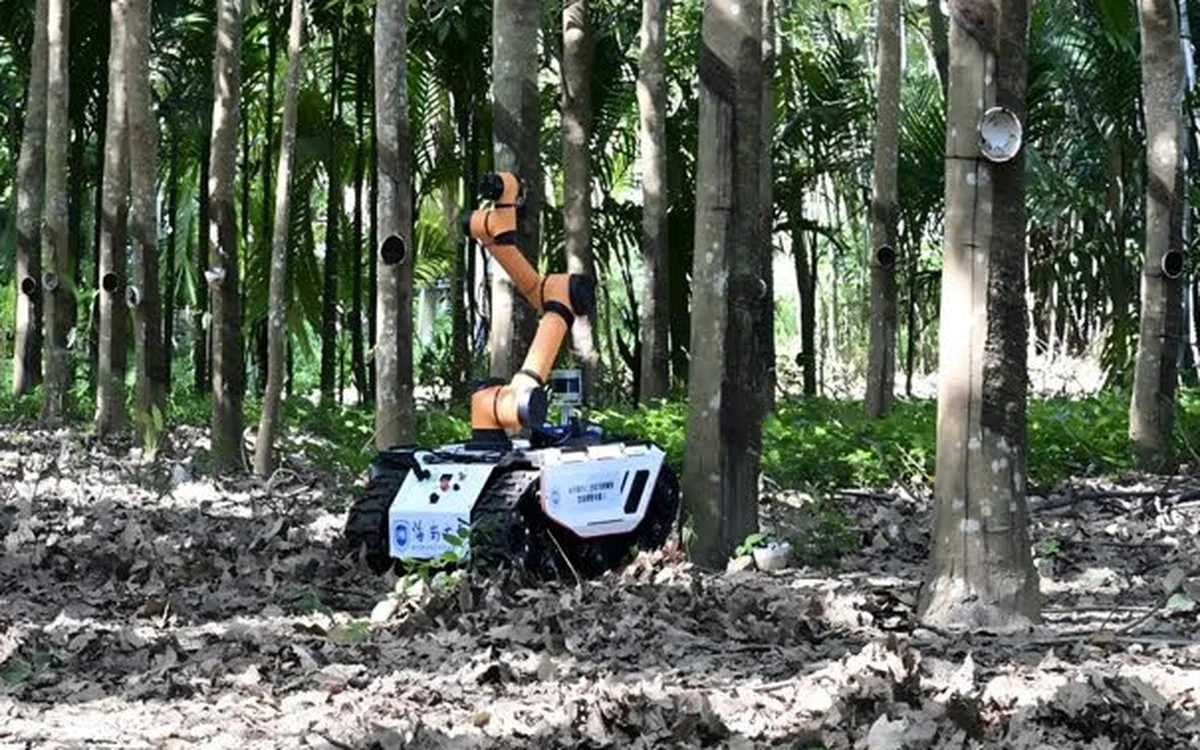
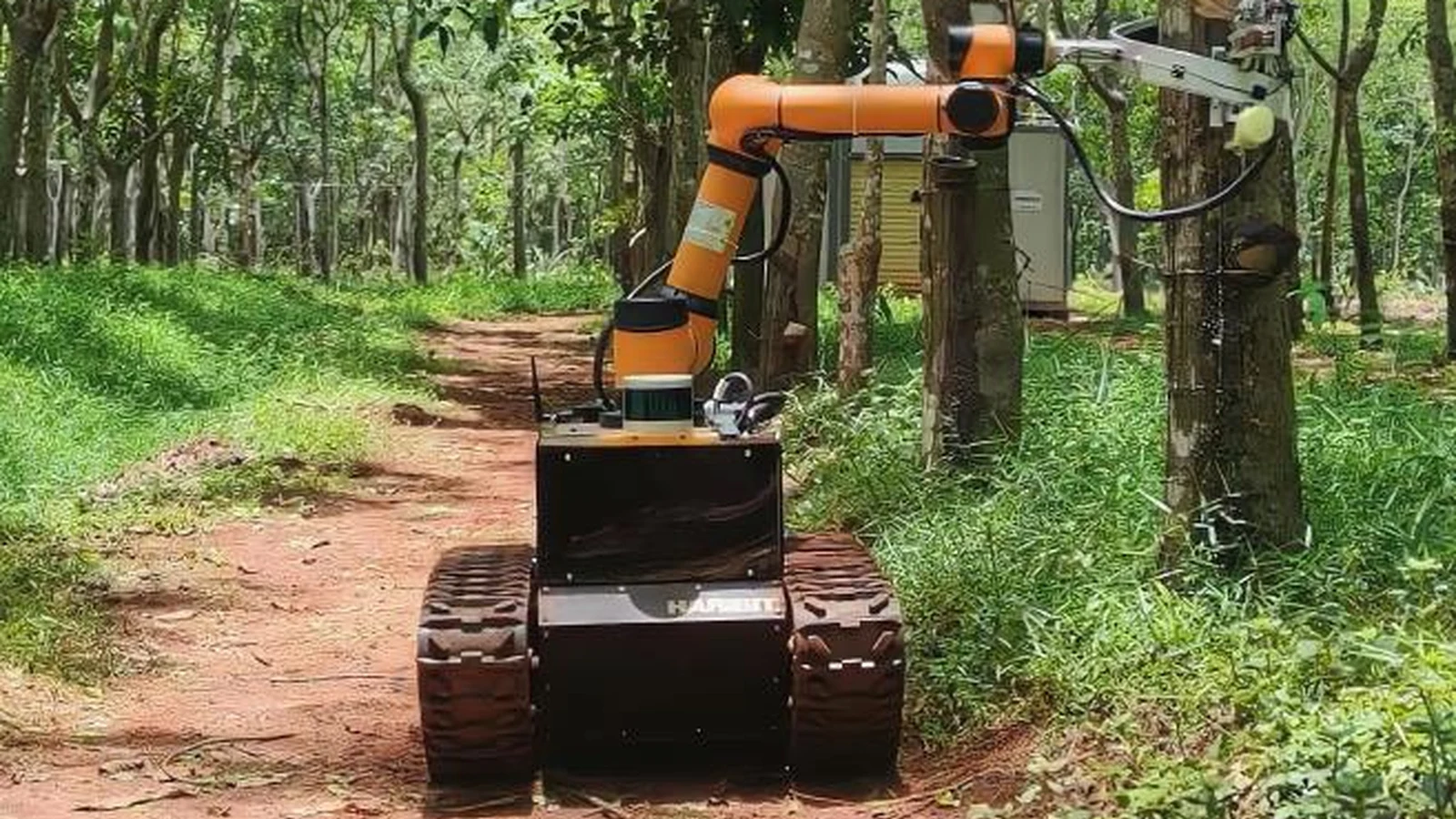
The best-known robot today is Chinese. The Chinese Academy of Tropical Agricultural Sciences (CATAS) built it with Automotive Walking Technology (AWT) of Beijing. It runs on tracks, uses laser radar (lidar) to find its way and a camera to judge bark depth, then reaches out with a robot arm to tap. The deputy director of the CATAS Rubber Research Institute told Xinhua that it taps 100–120 trees per hour and does about 80% of a human tapper's work. The battery lasts more than 8 hours and can be swapped in 20 seconds. In mass production the price would fall below 100,000 yuan (about 467,000 baht), with payback in about 18 months on a 50-mu plantation (about 20.8 rai) [1].
AWT's own website says it has built 5 generations and tested them on a 10-hectare plantation for more than 400 days. It claims 100–150 trees per hour, 90% of a human's work, and one robot covering more than 4 hectares [2]. The two sources do not agree (80% vs 90%), and both come from the developer side. We have not found any independent test results.
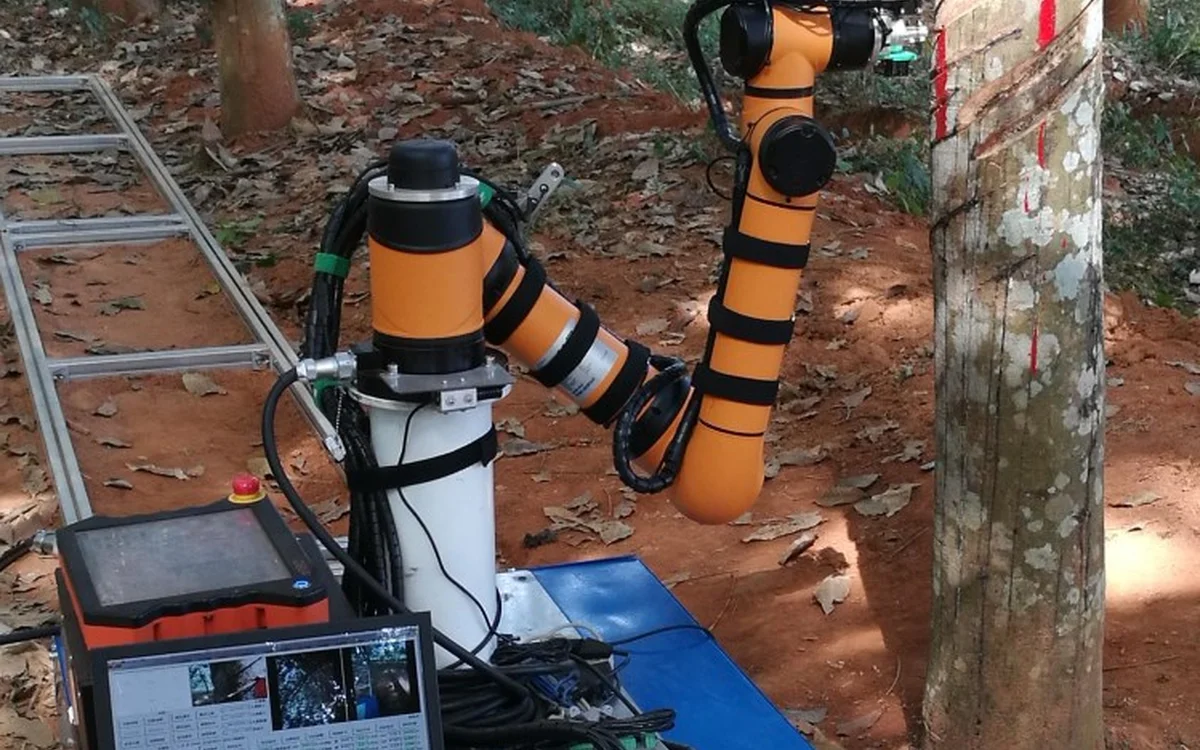
China is also testing a rail-mounted robot: a track runs in front of each row of trees, and a railcar carries the robot arm from tree to tree. The research team ran its field trials on a plantation in Danzhou, Hainan, in January 2020 [13].
Type 2: Fixed units (one machine per tree)
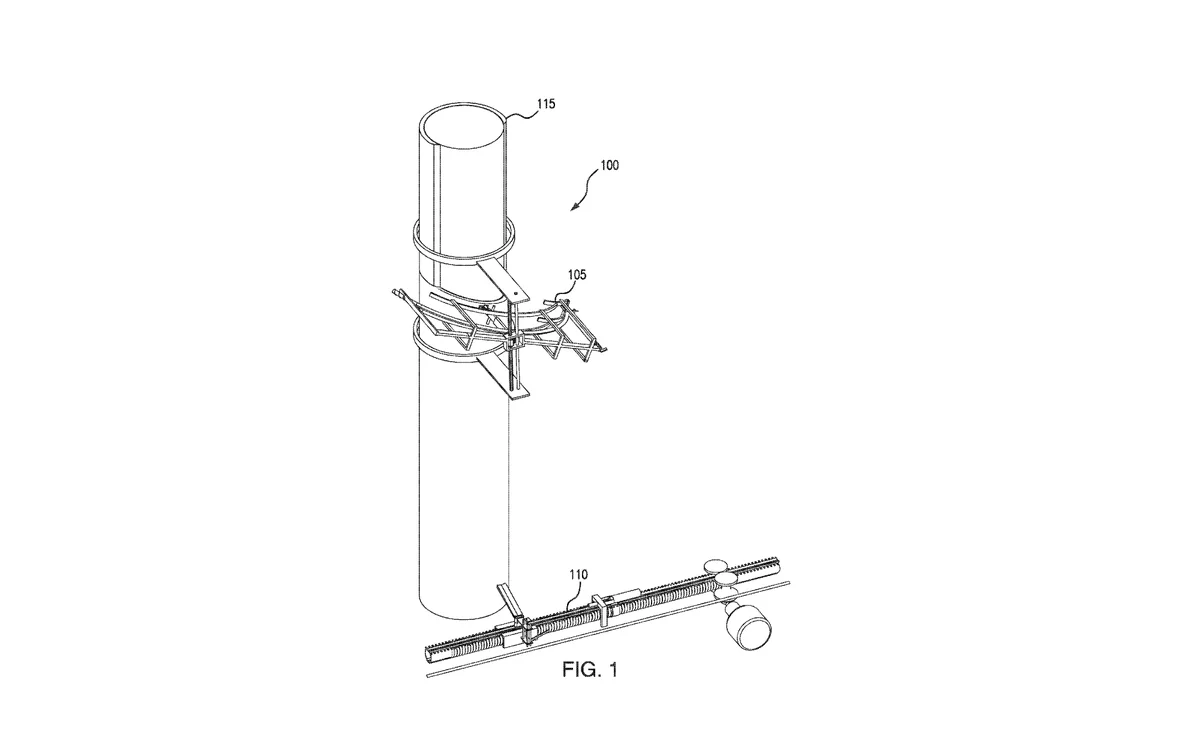
China has sold this type for some time. Yunnei, for example, sells a unit fixed to every tree and controlled from a central system. Its product page claims depth control of 1.2–1.8 mm and bark use of no more than 2 mm per tapping [3]. AWT also has a fixed unit built with CATAS. It says plainly that it aims to fix the problems of earlier fixed units: high cost, frequent breakdowns and low yield [2].
A 2025 Chinese study (tested by the development team itself) built a fixed unit that follows the shape of the bark. The abstract reports better control of tapping depth in field tests and estimates payback in 2–3 years. The authors say this type suits small and medium plantations better than costly ground robots [4].
The clear drawback: a plantation with a thousand trees needs a thousand machines. A Thai research team also raises this as a problem to solve [6].
Type 3: Cable robot (Thailand)
A team led by Asst. Prof. Panya Laoanantana at the Faculty of Engineering, Kasetsart University, built a cable robot with support from the Rubber Authority of Thailand (RAOT). Rubber trees serve as posts for a steel cable, and the robot travels along it. It can tilt when trees lean or the plantation is on a slope. One robot can cover a whole plantation. It runs on battery, generator or solar power [5][6]. RAOT says more research is needed to make it cheap enough for farmers to buy [5].
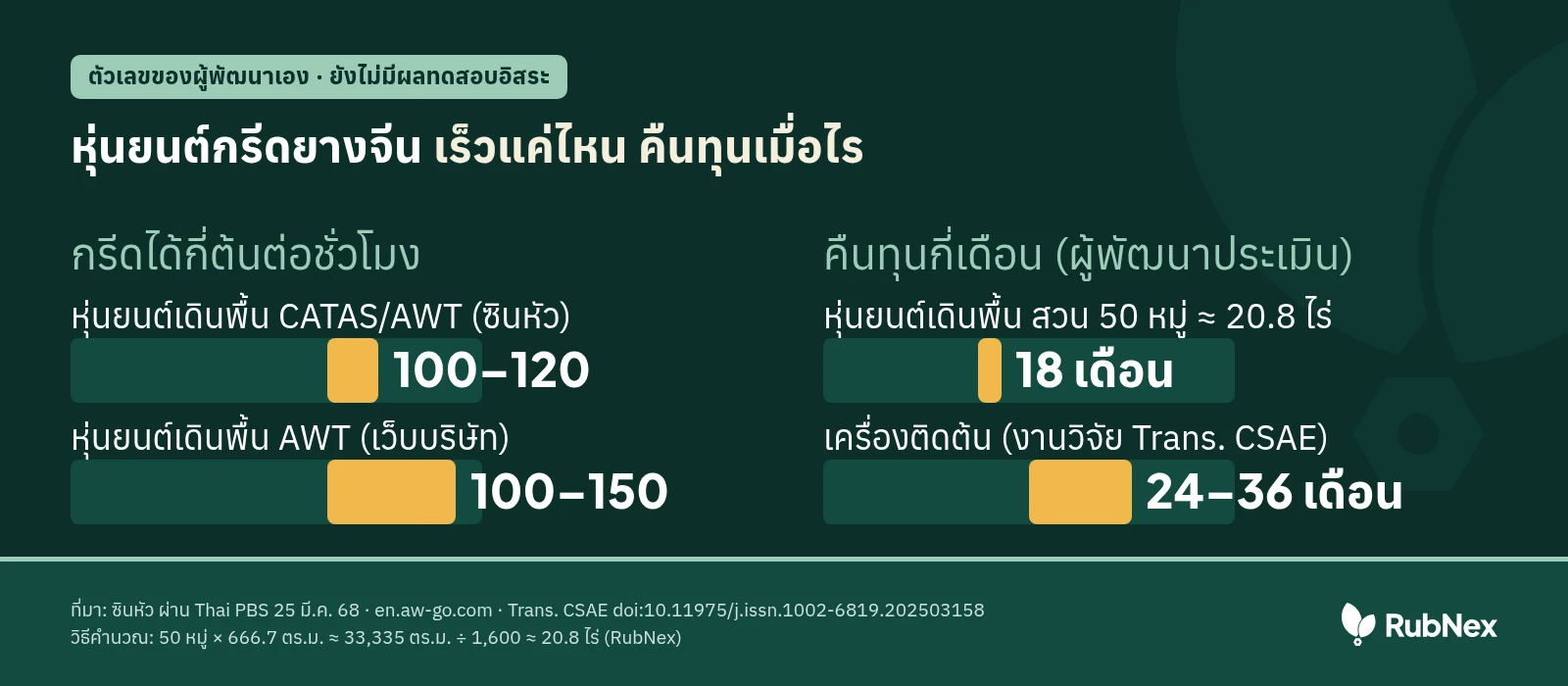
Chart sources: [1][2][4] · All figures are the developers' own claims
Group 2: change the harvest method so it needs less labour
Puncture tapping instead of cutting
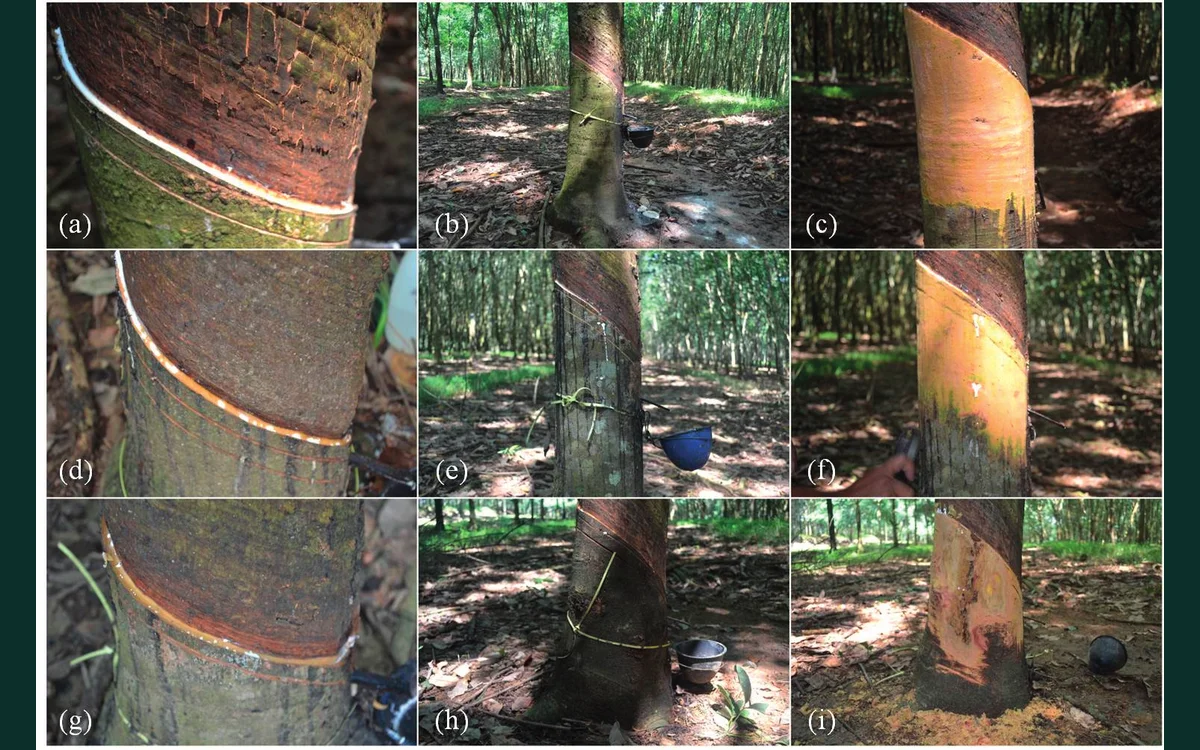
The idea is not new. It goes back to work by Tupy in 1973, who used needles to puncture bark treated with a hormone. It works because ethephon helps the latex flow (cited in a UPM thesis [9]). Work in Malaysia with clones RRIM 600 and PR 261 reported that puncture tapping gave yields close to half-spiral tapping without a hormone (per the abstract [9]).
There are cautions. Research by the Rubber Research Institute of Malaysia (RRIM) found that puncture tapping needs much stronger ethylene gas than normal tapping, because fewer latex vessels are opened. In young trees, in the first two years, conventional half-spiral tapping every 3 days still gave the most latex per tapping [8]. In short: puncture tapping works, but the hormone dose and tree health must be managed well.
Short-cut tapping with gas (RRIMFLOW, LET, Double Tex)
A trial in Songkhla, Thailand, with clone RRIM 600 used a short 1/8-spiral cut every 3 days plus ethylene gas. The abstract reports that the RRIMFLOW system gave the highest cup-lump yield per tapping of all systems tested [7]. The same study found this system had the lowest DRC (dry rubber content) and the slowest tree growth. The authors warn that the trial was short, and long-term results are needed [7].
Less frequent tapping with a hormone (India)
The Rubber Research Institute of India (RRII) ran a 15-year trial with clone RRII 105 in Kerala. Tapping every 3, 4 or 6 days with ethephon gave cumulative yields close to tapping every other day without a hormone. But tapping days fell from 2,161 to 1,470, 1,105 and 766 days. That means 32%, 49% and 65% less tapping labour [10].
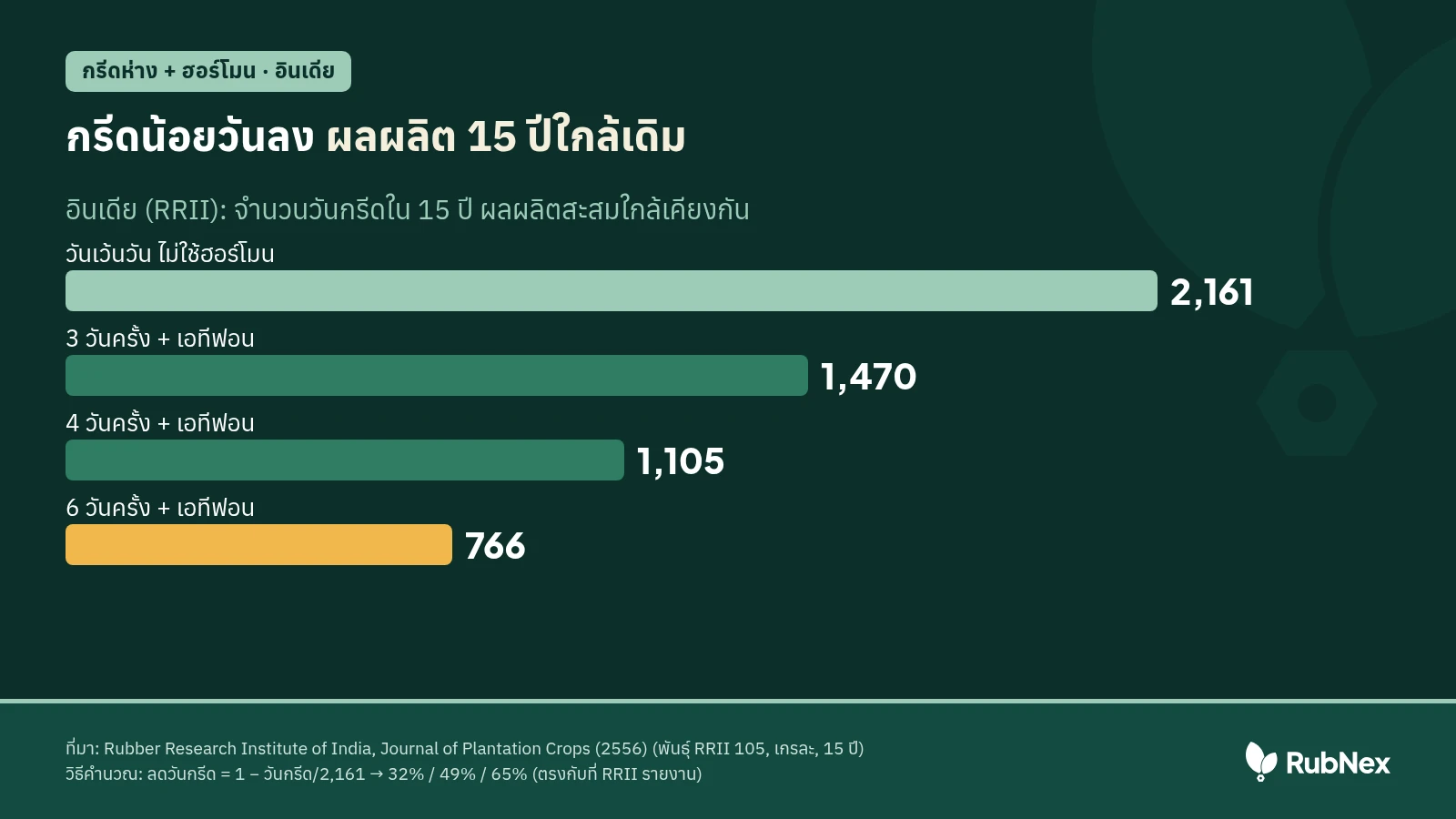
Chart: RubNex, from RRII [10]
One caution: a 2015 study found that frequent tapping combined with ethephon speeds up tapping panel dryness in clones that produce latex quickly [15].
Upward tapping (Côte d'Ivoire)
Research on smallholdings in south-east Côte d'Ivoire reported that upward tapping on virgin bark gave higher yields than downward tapping on renewed bark [11]. Another study with clone GT 1 found that starting upward tapping earlier (year 6 instead of year 10) raised yields [12].
Side-by-side comparison
| Method | Example developers | Pros | Cons / unknowns |
|---|---|---|---|
| Ground robot | CATAS + AWT (China) | One robot, many trees; developers claim 100–150 trees/hour [1][2] | Target price still close to 500,000 baht [1]; no independent tests yet |
| Fixed unit | Yunnei, AWT, TCSAE study (China) | Simple design; developers estimate 2–3 year payback [3][4] | One machine per tree; earlier models costly and unreliable [2][6] |
| Cable robot | Kasetsart University + RAOT (Thailand) | One robot per plantation; works on slopes [5] | Still research; cost must come down [5] |
| Puncture tapping | Malaysian research (RRIM/UPM) | Yield close to normal tapping (abstract) [9] | Needs strong ethylene; young trees still yield less than normal tapping [8] |
| Short cut + gas | RRIMFLOW, LET, Double Tex | Highest yield per tapping in the Songkhla trial [7] | Low DRC, slower growth, no long-term data [7] |
| Low frequency + hormone | RRII (India) | 32–65% fewer tapping days; 15-year yield close to baseline [10] | Ethephon must be applied on schedule; added hormone cost |
| Upward tapping | Côte d'Ivoire | Higher yield than downward tapping on renewed bark [11] | Still needs a tapper; no labour saving |
RubNex view
Taken together, no method is "finished" yet. Chinese robots have gone furthest on machinery, but the figures still come from the developers, and the price is still too high for Thai smallholders. The methods usable today are low-frequency tapping with a hormone, as in India, where a 15-year study found up to 65% fewer tapping days [10], and short-cut tapping with gas, as in Malaysia, which gives more rubber per tapping but lower DRC [7]. Both need good tree care, or the losses can outweigh the gains.
Before paying for any new method, farmers should ask three questions. What is the cost per rai? What are the long-term yield and DRC? How much damage does it do to the tapping panel? If a seller cannot answer these with real test results, there is no need to rush.
How RubNex calculated: 50 mu × 666.7 m² ≈ 33,335 m² ÷ 1,600 ≈ 20.8 rai [1] (1 rai = 1,600 m²) · 65% fewer tapping days = 1 − 766/2,161 [10] (matches RRII's figure) · 467,000 baht is Thai PBS's conversion [1]
Note: RubNex, which runs this website, is developing RubBOT, a puncture-based latex harvesting device. That is one of the methods discussed in this article. It is still a prototype, and no test results have been published. · This article does not yet cover Indonesia, Europe, Japan or patents; we will follow up in a later piece. · We could not open the full papers for [4] [7] [9] [11] [12], so we report only their abstract-level conclusions.
Charts: RubNex, from figures by Xinhua/Thai PBS, AWT, Trans. CSAE and RRII
Abbreviations
- CATAS: Chinese Academy of Tropical Agricultural Sciences
- AWT: Automotive Walking Technology (Beijing) Co., Ltd.
- RAOT: Rubber Authority of Thailand
- RRIM: Rubber Research Institute of Malaysia
- UPM: Universiti Putra Malaysia
- LET / RRIMFLOW / Double Tex: short-cut tapping systems combined with ethylene gas
- DRC: dry rubber content (%)
- RRII: Rubber Research Institute of India
- TCSAE: Transactions of the Chinese Society of Agricultural Engineering
- LGM: Lembaga Getah Malaysia (Malaysian Rubber Board)
Sources
- Solving the tapper shortage: China develops an AI-powered rubber-tapping robot (citing Xinhua) · Thai PBS Sci & Tech
- Autonomous Rubber Tapping Robot / Fixed Tapping Machine (product page) · Automotive Walking Technology (Beijing) Co., Ltd. (AWT)
- Fully Automatic Intelligent Rubber Tapping Machine (product page) · Yunnei (yunneiglobal.com)
- Development of a fixed-type profiling depth control rubber tapping machine using ADAMS · Transactions of the CSAE
- RAOT showcases rubber-tapping robot innovation, promotes ethylene hormone to raise yields (RAOT press release) · Khaosod (RAOT press release)
- Kasetsart University researchers invent a rubber-tapping robot: one unit taps a whole plantation · Technology Chaoban (Khaosod)
- Testing of ethylene stimulation to enhance latex yield of Hevea brasiliensis clone RRIM 600 in Southern Thailand · AICS-SciEng (Universitas Syiah Kuala)
- Research article on puncture tapping with gas stimulation (REACTORRIM) in young rubber trees · Journal of Rubber Research / Malaysian Rubber Board (LGM) repository
- Effect of puncture tapping on yield performance of clones RRIM 600 and PR 261 (thesis FP 1996 6) · Universiti Putra Malaysia
- Long term yield response of low frequency tapping and yield stimulation in clone RRII 105 · Journal of Plantation Crops (Rubber Research Institute of India)
- Improving productivity of smallholdings by introduction of upward tapping in the south-east of Côte d'Ivoire · Journal of Rubber Research / LGM repository
- Improvement of productivity of clone GT 1 by early upward tapping in Côte d'Ivoire · American Journal of BioScience 9(1)
- Evaluation of Cutting Stability of a Natural-Rubber-Tapping Robot · Agriculture 13(3):583 (MDPI)
- System for tapping and collecting rubber (US 9,974,244 B2) · USPTO (via Google Patents)
- Involvement of Ethylene in the Latex Metabolism and Tapping Panel Dryness of Hevea brasiliensis · International Journal of Molecular Sciences 16(8):17885 (MDPI)
- An autonomous navigation system with a trajectory prediction-based decision mechanism for rubber forest navigation · Scientific Reports 14:29495 (Nature)
Images: Fang J., Shi Y., Cao J., Sun Y., Zhang W. (Remote Sensing 15(15):3717 Fig. 1a, cropped by RubNex) (CC BY 4.0) · Zhang X., Liu Y., Liu J. et al. (Scientific Reports 14:29495 Fig. 10c, cropped by RubNex) (CC BY 4.0) · Zhou H., Gao J., Zhang F. et al. (Agriculture 13(3):583 Fig. 3a, rotated and cropped by RubNex) (CC BY 4.0) · US Patent US 9,974,244 B2, Fig. 1 (Hanmin Hu, 2018) (US patent document, no copyright claimed) · Putranto R.-A., Herlinawati E. et al. (Int. J. Mol. Sci. 16(8):17885 Fig. 1) (CC BY 4.0)